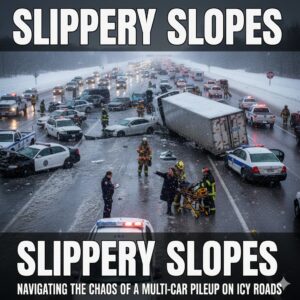
Winter driving is often a stressful balancing act, but nothing prepares you for the moment you see brake lights spinning out of control ahead of you. When the roads turn into skating rinks, a single minor slide can quickly cascade into a massive multi-car pileup involving dozens of vehicles. If you find yourself caught in the middle of this twisted metal and shattered glass, the confusion doesn’t end when the sirens fade. Figuring out the legal options for victims of highway collisions is a complex puzzle because icy conditions add a layer of “Act of God” defenses that insurance companies love to hide behind. Understanding how liability works in these massive wrecks is the first step toward getting your life back on track.
The Myth of the Blameless Ice Patch
A common misconception after a winter pileup is that nobody is at fault because the ice was the “cause” of the accident. While it is true that patches of black ice are dangerous, the law generally expects drivers to adjust their behavior to the environment. In the eyes of a claims adjuster or a jury, the ice is a condition, not an excuse.
Liability usually comes down to negligence. Did the driver at the very front of the pileup take an exit ramp too fast? Did the person behind you fail to leave enough stopping distance despite knowing the roads were slick? Even if everyone was going under the speed limit, they might still be liable if their speed was too high for the current conditions. Proving who started the chain reaction requires a deep dive into police reports and witness statements.
Untangling the Chain of Liability
In a two-car accident, fault is usually straightforward. In a multi-car pileup, it is a nightmare. This is often referred to as “chain reaction liability.” Usually, investigators look for the “primary” negligent party—the person whose initial mistake set everything in motion. However, there can also be “secondary” negligence.
For instance, if Driver A spins out because they were texting, they are likely at fault. But if Driver C was following too closely and slammed into Driver B instead of stopping in time, Driver C might share a portion of the blame for the secondary impact. Many states use a comparative negligence system, meaning the total “blame” is divided as a percentage among several different drivers.
Immediate Steps to Protect Yourself at the Scene
If you are involved in a pileup, your priority is physical safety. If your car is still movable, try to get it to the shoulder, but stay inside the vehicle with your seatbelt on if traffic is still moving. Stepping out onto an icy highway is a recipe for a secondary pedestrian accident.
Once the scene is secured by emergency responders, start your own documentation. Take photos of the road conditions, the positions of the cars, and any visible ice or slush. Exchange information with as many people as possible, but avoid apologizing or saying things like “I just didn’t see the ice.” Those casual remarks can be used against you later to shift 100 percent of the blame onto your shoulders.
Dealing with Multiple Insurance Companies
The biggest headache in a multi-car wreck is the sheer number of insurance companies involved. Each company will try to point the finger at a different driver to avoid paying out a massive claim. This often leads to “finger-pointing stalemates” where your claim sits in limbo for months while adjusters argue over who hit whom first.
This is why having your own collision coverage and PIP (Personal Injury Protection) is vital. Your own insurance may cover your immediate repairs and medical bills, and they will then “subrogate,” which is a fancy way of saying they will fight the other drivers’ insurance companies to get their money back later.
When the Government Shares the Blame
Sometimes, the liability goes beyond the drivers. If a stretch of highway was known to be a death trap and the local municipality or Department of Transportation failed to salt or sand the road within a reasonable timeframe, there might be a claim for negligent road maintenance.
These cases are incredibly difficult to win because government entities often have “sovereign immunity,” which protects them from many lawsuits. However, if there was a documented failure to follow safety protocols or a known drainage issue that caused ice to pool in a specific spot, a skilled legal team might be able to hold the state or city accountable.
Final Word
The aftermath of a pileup is an exhausting cycle of doctor visits and phone calls with adjusters who don’t want to pay. Because the evidence on the road melts away within hours, you have to act fast to preserve your rights. Navigating the legal options for victims of highway collisions requires patience and a clear understanding of how negligence works in winter weather. You don’t have to face the insurance giants alone while you are trying to heal, so make sure you have the right support to help you sort through the wreckage.

