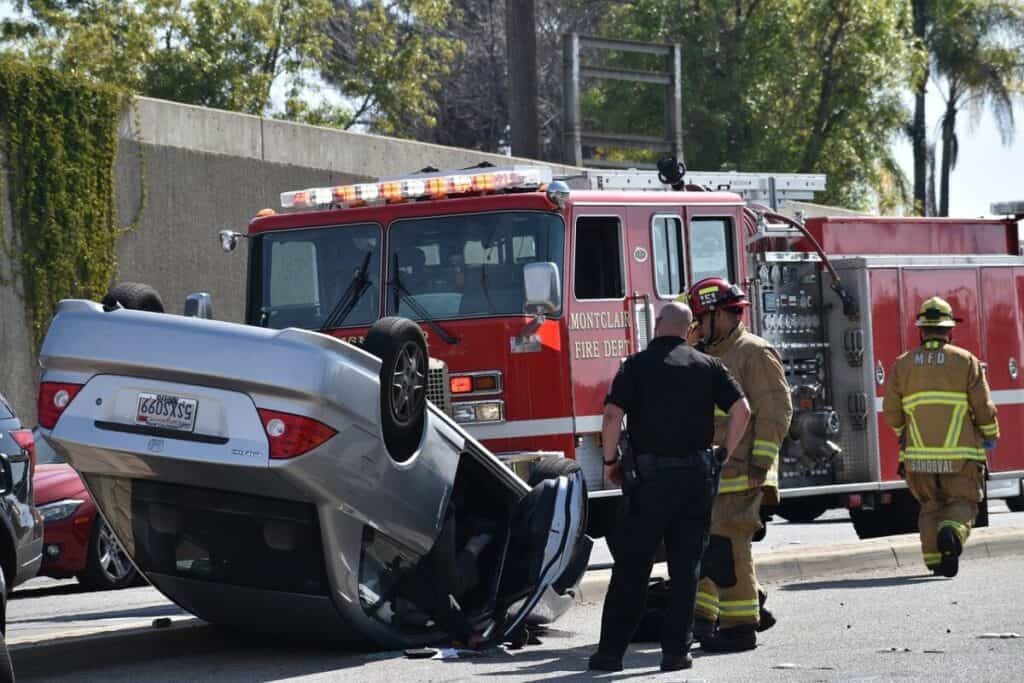
Car accidents are tough to deal with even in the simplest circumstances.
But add a few more vehicles, and suddenly it’s a nightmare of liability issues, shared fault questions, and complicated legal analysis.
The thing is…
Navigating liability in multi-car pileups and other complex accident cases can make or break your claim to compensation.
In this article:
- The Complex Accident Cases Reality
- Split Fault in Multi-Car Accidents
- Chain Reaction Crash Explained
- Comparative Negligence Explained
- Protecting Your Car Accident Claim
The Complex Accident Cases Reality
First, let’s go over some stats.
The NHTSA estimates 39,345 people died in traffic crashes in 2024. That’s a 3.8% reduction from 2023 and the first year fatalities have dropped below 40,000 since 2020.
The good news?
Fatal car accidents are decreasing. But there are still millions of cases happening yearly, many of which involve multiple vehicles and complex liability issues.
The minute more than two vehicles get into an accident, things start to get very messy. Insurance companies start blaming each other. Drivers get angry and start pointing fingers. Suddenly you are right in the middle of this fight trying to figure out where you stand.
This is why having experienced car accident lawyers working on your case from the start becomes crucial. Knowing how liability is determined and how shared fault affects your claim is key to recovering fair compensation.
Split Fault in Multi-Car Accidents
What most people don’t realize is that, in multi-vehicle accidents, liability is not just put on one driver. It’s usually shared among multiple parties, and each state has different laws regarding comparative negligence. Let’s go over the three systems used by states to divide up liability in multi-car crashes.
1. Pure Comparative Negligence
Under pure comparative negligence, you are allowed to recover damages based on your percentage of fault. So, if the court finds you 90% at fault, you can still recover 10% of your damages. Only 12 states follow this rule.
2. Modified Comparative Negligence
Modified comparative negligence only allows you to recover if your fault is below a certain threshold. This threshold is either 50% or 51% depending on the state, and your damage award will be reduced by your percentage of fault. Most states follow this rule.
3. Contributory Negligence
Contributory negligence is the harshest rule. If you are found to be even 1% at fault in a contributory negligence state, you are completely barred from recovering any damages. Only a few states still follow this rule.
Think of it this way.
If a court awards you 30% liability and the other driver 70%, then in a pure comparative negligence state you could recover the total value of your damages minus 30%. But if you were found over 50% at fault in a modified comparative negligence state, you would recover $0.
That’s pretty harsh.
Chain Reaction Crash Explained
Chain reaction accidents are some of the most complicated car accident cases to deal with.
The reason is these crashes happen when one vehicle hits another, then the second vehicle is pushed into a third. A big mess ensues, and sometimes more than three vehicles are involved.
Chain reaction accidents are also called ‘domino effect’ crashes due to the car-pileup that occurs. According to the U.S. NHTSA, there are nearly two million multiple-car accidents every year in the United States alone.
Who is at fault in a chain reaction crash?
The general rule is: The first driver who caused the initial collision is usually found primarily liable. If Car A hits Car B, which pushes into Car C, the first driver will typically have to pay all other drivers’ damages.
But it is not always that straightforward.
Shared fault can occur when:
- A driver is following too closely.
- A driver does not react in a reasonable amount of time after being hit.
- A driver is speeding, distracted, or has non-working brake lights.
In some cases, the car stopped suddenly without a good reason can actually be at fault and the trigger the chain reaction. Even the first car in a multi-car pileup can share liability if their actions were deemed negligent.
Evidence That Determines Liability
Investigators take these types of collisions very seriously.
Determining fault in complex car accident cases involves police reports, witness statements, traffic camera footage, and accident reconstruction analysis.
Here is the key evidence usually gathered:
- Photos and videos from the scene
- Vehicle damage patterns that show impact sequence
- Skid marks and final vehicle positions
- Cell phone records indicating distracted driving
Accident reconstruction experts use scientific methods and engineering principles to re-create the exact sequence of events that took place during the collision. In a multi-vehicle accident where each driver is trying to shift blame, this evidence is used to back up your claims.
What Comparative Negligence Means For You
Let’s look at some practical applications of comparative negligence in multi-car accidents.
In a modified comparative negligence state, if you are found more than 50% responsible for an accident, you cannot recover damages. But if you are 50% or less at fault, you are still eligible to recover compensation reduced by your percentage of fault.
For example:
You’re involved in a three-car pileup. Investigation proves the first driver is 60% at fault, you are 25% at fault for following too closely, and the third driver is 15% at fault for speeding. Total damages amount to $100,000.
Under a modified comparative negligence system, you would recover $75,000 (minus your 25% fault). The first driver’s insurance would pay for their share, the third driver’s would pay for theirs.
The tricky part is that each insurance company will fight to reduce their client’s percentage of fault.
Insurance adjusters and investigators will get involved from day one to protect their companies’ bottom line. With multiple insurance companies fighting over a pileup, negotiations can get contentious.
Steps to Protect Your Claim
If you are involved in a multi-vehicle accident, it is important to take the right steps to protect your claim.
Immediately at the scene, do the following:
- Document everything with photos and videos of the vehicles before they are moved
- Exchange insurance information with all drivers, not just the one you are involved with
- Get the names and contact info of witnesses
- Call law enforcement and request a police report
- Seek medical attention even if your injuries seem minor
- Don’t give recorded statements to other drivers’ insurance companies
- Keep detailed records of all your medical treatments and expenses
- Consult with legal counsel before accepting any settlement offer
Insurance adjusters may call you as soon as a few days after a multi-car crash, trying to get a recorded statement that can be used against you later. This is their job, after all, and they are trained to lead people into saying the wrong things.
An oral release of a claim is valid and binding. Never accept a settlement without knowing the full extent of your injuries.
Wrapping Things Up
Complex car accident cases involving multiple vehicles require a different approach than single two-car crashes.
Liability is usually split among several parties, and understanding how comparative negligence works in your state affects your ability to recover compensation.
The bottom line is that multi-vehicle accident investigations take time. Weeks, even, to sort out which driver hit which, in what order, and why.
You can put yourself in the best position to recover full compensation by documenting everything and understanding your rights under your state’s comparative negligence laws.
