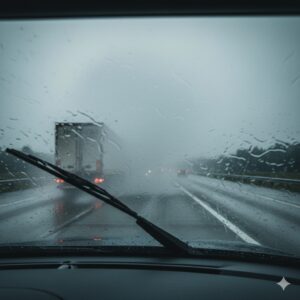
You are cruising down the highway during a downpour, the wipers are fighting a losing battle, and suddenly a massive semi-truck passes you in the left lane. In an instant, your world turns into a wall of gray opaque mist. This phenomenon, known as road spray, is a leading cause of highway pileups because it literally erases a driver’s vision for several seconds at a time. If you find yourself in a wreck because of these conditions, reaching out to a personal injury legal team can help you navigate the complex insurance claims that follow. While we often worry about hydroplaning, the science of splash is just as deadly.
The Physics of the Water Wall
Road spray is not just regular rain. When a vehicle, especially a heavy one with large tires, moves over a wet surface, it interacts with the standing water in a high-energy exchange. As the tire rotates, it picks up water from the pavement and flings it backward and upward. Because the tire is spinning fast, it atomizes the water, breaking large drops into a fine, dense mist.
This mist is much harder to clear than raindrops. Standard rain falls in distinct droplets that gravity pulls off your windshield, but road spray is a suspension of tiny particles that cling to the glass. To make matters worse, this spray is rarely clean water. It is a cocktail of motor oil, road grime, salt, and tire particles. This oily mixture creates a smeary film that catches the light from oncoming headlights, creating a “white out” effect that makes it impossible to see the brake lights of the car in front of you.
The Vacuum Effect and Aerodynamics
The shape of modern vehicles actually makes road spray worse. As a car or truck moves forward, it displaces air, creating a zone of high pressure in the front and a zone of low pressure in the back. This low-pressure area acts like a giant vacuum, sucking the fine mist upward and keeping it suspended in the air long after the vehicle has passed.
This is why you can be driving a hundred feet behind a truck and still have your visibility obscured. The “wake” of a large vehicle can extend far behind it, creating a tunnel of blinding fog. For drivers in smaller passenger cars, this means your entire field of vision is dominated by the turbulent air and water kicked up by the larger tires of SUVs and commercial rigs.
Human Perception and Reaction Times
The real danger of road spray lies in how our brains process sudden changes in visual data. Human reaction time is roughly 1.5 seconds under normal conditions. However, when you are suddenly splashed, your brain goes into a “startle response.” You might instinctively slam on the brakes or jerk the steering wheel, both of which are dangerous on slick roads.
Because road spray reduces contrast, you lose your ability to judge distance. You might think the car ahead is a safe distance away, but because the mist diffuses its taillights, they appear further than they actually are. By the time you realize they are braking, the physics of wet pavement make it nearly impossible to stop in time. This delay in perception is what leads to the multi-car chain reactions we often see during heavy storms.
Defensive Strategies for Heavy Spray
Since we cannot control the physics of water, we have to change how we drive. The most important rule is to increase your following distance to at least double what it would be on a dry day. This gives the spray from the car ahead a chance to settle before it hits your windshield.
Also, check your wiper blades. If they are older than six months, they likely have microscopic tears that leave streaks, which only amplify the glare from road spray. Using a rain repellent treatment on your glass can also help water bead up and roll off faster, preventing that solid wall of gray from taking over your view. Most importantly, turn on your actual headlights, not just your daytime running lights, so that your rear markers are visible to the people behind you who are struggling to see through your own spray.
Final Word
Driving through a storm is stressful enough without the added terror of being blinded by a passing vehicle. If the worst happens and a visibility-related crash upends your life, consulting with a personal injury legal team is the best way to protect your rights while you recover. Stay focused, slow down, and remember that being seen is just as important as being able to see.

