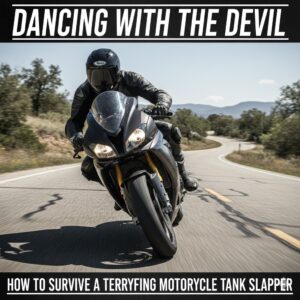
If you have spent enough time on two wheels, you have likely heard the term “tank slapper” spoken in hushed, nervous tones at bike nights. It is the stuff of nightmares: the handlebars begin to whip violently from side to side, slamming against the fuel tank with enough force to bruise your knees or even buck you off the bike. While these moments are heart-stopping, they do not always have to end in a trip to the hospital. Knowing how to handle your machine when it rebels is vital, but if the worst occurs due to road defects or mechanical negligence, consulting an attorney for victims of motorcycle wrecks can help you navigate the legal aftermath. Staying calm and understanding the physics of your motorcycle is the best way to keep the rubber side down when things get shaky.
What Exactly Is a Tank Slapper?
In technical terms, a tank slapper is a high-speed oscillation of the front wheel. It usually starts when the front tire loses contact with the ground or skips over a bump while under heavy acceleration. When the tire touches back down, it might not be perfectly aligned with the direction of travel.
The motorcycle’s geometry naturally tries to self-correct, but sometimes it overshoots the mark. This creates a pendulum effect. The front end swings left, then right, with increasing intensity until the bars are literally slapping the tank. It feels like the bike is trying to shake you off, and in many cases, that is exactly what will happen if you fight it the wrong way.
Prevention Is the Best Medicine
The easiest way to survive a tank slapper is to never have one in the first place. While you cannot control every bump in the road, you can control how your bike handles them.
- Check Your Tire Pressure: Under-inflated or unevenly worn tires are a leading cause of instability. A “squared-off” rear tire or a cupped front tire can change how the bike tracks, making it more prone to wobbles.
- Maintain Your Suspension: If your fork seals are leaking or your rear shock is blown, the bike will bounce instead of absorbing impacts. Properly tuned suspension keeps the tires glued to the pavement.
- Check Steering Head Bearings: If these bearings are loose or notched, the front end cannot pivot smoothly. This creates a “dead spot” that can trigger an oscillation at high speeds.
- Invest in a Steering Damper: This is essentially a shock absorber for your steering. It allows the bars to turn slowly for parking lot maneuvers but resists the rapid, violent movements associated with a tank slapper.
What to Do When the Shaking Starts
If you find yourself in the middle of a violent wobble, your instincts will likely tell you to do the exact opposite of what you should actually do. Here is how to handle the crisis in real time.
Relax Your Grip
It sounds insane to let go when the bars are trying to fly out of your hands, but death-gripping the handles only feeds the energy back into the frame. Your body becomes a rigid lever that amplifies the vibration. By loosening your grip and keeping your elbows flexible, you allow the motorcycle’s natural geometry to find its own center.
Do Not Slam on the Brakes
Hitting the front brake is the fastest way to crash during a tank slapper. Braking shifts the weight of the bike forward, compressing the forks and shortening the wheelbase. This makes the steering even more twitchy and aggressive. If you must use a brake, a light touch on the rear brake can sometimes help settle the chassis, but generally, you want to avoid abrupt changes in speed.
Lean Forward and Weight the Pegs
Try to get your chest closer to the tank. This lowers the center of gravity and changes the wind resistance on your body, which can sometimes break the harmonic frequency of the wobble. Putting weight into the footpegs rather than the seat can also help stabilize the bike’s center of mass.
Roll Off the Throttle Gradually
While some old-school riders suggest “powering out” of a wobble, this is dangerous for most people because it requires a massive amount of engine torque and perfect timing. For the average rider, the best move is to gently roll off the throttle. Do not chop it shut, as that also shifts weight forward. Just ease back and let the bike lose momentum until the physics of the wobble die down.
Why Experience Matters
Most tank slappers happen because of a combination of high speed, aggressive throttle, and an uneven road surface. If you are a newer rider, taking an advanced rider course can help you develop the muscle memory needed to stay calm. Experience teaches you that the bike actually wants to stay upright. Most of the time, the machine is trying to fix itself, and the rider is the one getting in the way.
Final Word: Picking Up the Pieces
If a tank slapper sends you into the pavement, the physical and emotional toll is significant. Often, these accidents are caused by poorly maintained roads, such as “expansion joints” or “grooved pavement,” that the city failed to fix. In these instances, having an attorney for victims of motorcycle wrecks on your side is essential to ensure that your rights are protected and your medical bills are covered. No one expects their Sunday ride to turn into a fight for survival, but being prepared for the “wobble” can make the difference between a scary story and a tragic one. Stay loose, keep your gear on, and respect the machine.

