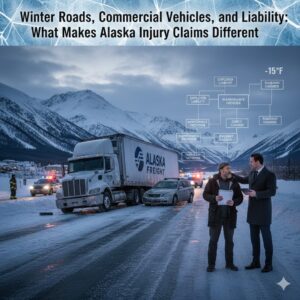
Alaska accident claims have a different DNA than most of the lower 48. Weather, distance, road conditions, commercial vehicle traffic, and delayed emergency response all shape how collisions happen and how liability gets evaluated afterward.
That difference matters, because many injury cases don’t turn on dramatic “who’s at fault” moments. They turn on practical questions:
- Did a driver adapt to road conditions?
- Did a company follow safety and maintenance procedures?
- Did a roadway hazard contribute to the crash?
- Was evidence preserved in time?
In colder climates with high-risk road environments, small details carry outsized weight.
Weather doesn’t “cause” the crash—people’s decisions do
Snow and ice are often treated like a legal excuse, but that’s not how liability analysis works.
Harsh conditions change the baseline expectation of reasonable driving behavior. A driver who is “technically within the speed limit” can still be negligent if conditions required lower speed, longer stopping distance, or more cautious maneuvering.
Insurance carriers typically evaluate:
- Speed relative to conditions
- Following distance
- Tire condition and maintenance
- Lane position and control
- Whether the driver attempted unsafe passing
- Whether visibility should have changed behavior
The key issue isn’t whether the road was icy. It’s whether the driver acted reasonably for that ice.
Commercial and work vehicles raise the stakes fast
Alaska has a heavier mix of commercial and work vehicles than many regions—trucks, contractors, delivery vehicles, and industrial traffic. When those vehicles are involved, liability can expand beyond the driver.
Potential responsible parties can include:
- The employer (if the driver was working)
- A maintenance provider (if mechanical failure contributed)
- A shipper or loader (if cargo contributed to instability)
- A manufacturer (if a defect played a role)
This is why serious truck or work-vehicle accidents often require deeper investigation. Commercial policies can be larger, but commercial defense tactics can be more aggressive.
Remote conditions can change injury outcomes—and claim value
In Alaska, distance isn’t just geography—it’s a factor in medical consequences.
Delayed EMS response, longer transport times, and limited immediate medical access can worsen injuries. That doesn’t mean the original crash was “more severe,” but it can change:
- Treatment timelines
- Prognosis
- documentation patterns
- long-term effects
Insurers may argue that later complications aren’t tied to the incident. The reality is that in remote environments, injuries often evolve differently. Claims should be built with those real-world constraints in mind, not treated like a generic metro crash file.
Roadway hazards and maintenance: when the environment becomes part of liability
Another Alaska-specific factor is roadway condition management.
In certain cases, hazards such as:
- untreated ice patches
- inadequate plowing
- poor signage
- dangerous road design
- debris left on roadways
can become part of a claim evaluation. When roadway condition is a factor, claims can become more technical and time-sensitive. Evidence must be documented quickly before conditions change.
Even when government or third-party responsibility isn’t the primary claim path, roadway conditions still influence fault arguments. Insurers love to blame “the road” in a way that reduces payout—unless the claimant has proof showing the other driver still acted unreasonably.
Evidence matters more in Alaska because conditions change faster
In warmer climates, a crash scene can remain stable. In Alaska, the scene often disappears.
Snowfall, plows, thaw/refreeze cycles, and limited daylight can erase key information. That’s why evidence collection needs to be immediate:
- Photos of road surface and visibility
- Tire tracks and vehicle final positions
- Nearby signage (or lack of it)
- Witness contact details
- Dashcam and security footage requests
If an accident involves a commercial vehicle, preserving electronic data early can be critical too. Many systems overwrite or purge data quickly.
Why insurers push fast settlements in winter-region claims
One pattern that shows up repeatedly in winter-region crashes is early settlement pressure.
Insurers know people want closure. They also know evidence gets harder to prove as conditions change. So they push early offers while medical outcomes and documentation are still developing.
The risk is obvious: accepting early limits recovery if symptoms evolve, complications appear, or long-term treatment becomes necessary.
If a crash leads to serious injury, many people seek clarity from Alaska personal injury lawyers before signing releases or closing a claim—especially when a commercial vehicle, a hazardous roadway condition, or a disputed liability scenario is involved.
The bottom line
Alaska claims are not “harder” because the law is different—they’re harder because the environment is different.
Injury outcomes, evidence preservation, roadway conditions, and commercial vehicle involvement all make these cases more complex than the average accident claim.
If you approach an Alaska collision like a standard “exchange insurance and move on” incident, you can end up under-compensated simply because the claim wasn’t built with Alaska realities in mind.

