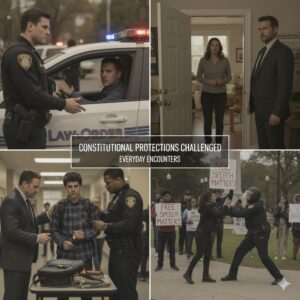
Constitutional law can feel distant, like something that lives only in courtrooms and history books. In reality, many people feel their rights are tested in small, everyday moments with police, school staff, or other officials. In those moments, guidance through civil rights litigation and federal claims may seem far away, but the principles behind those rights still matter.
Everyday Encounters Where Rights Are On The Line
Most rights questions do not begin with a judge or a long legal brief. They start in a parking lot, a school hallway, or at a routine traffic stop. An officer asks a question, a person nervously answers, and the line between cooperation and pressure blurs.
The law may be clear on paper, but people do not walk around with casebooks in their pockets. In those tense minutes, power differences shape what really happens. That is where constitutional protections are quietly tested.
Traffic Stops And The Fourth Amendment
A simple traffic stop is one of the most common rights crossroads. An officer pulls someone over for speeding or a broken light. The driver may feel like they must agree to any request just to avoid trouble.
Questions can move quickly from license and registration to “Mind if I look in your car?” The driver might think refusal is not an option, even though the law requires consent to be voluntary. Fear, surprise, and flashing lights make it hard to think clearly.
If the officer leans on vague language or an intimidating tone, a “yes” might not feel like a real choice. Yet that one word can change everything about what officers can search and use later. In that way, many search-and-seizure issues begin in minutes on the side of the road.
Home Doorsteps And “Voluntary” Conversations
Rights get tested at front doors, too. Officers, investigators, or other officials sometimes show up without a warrant. They knock, introduce themselves, and say they just want to “ask a few questions.”
Most people feel pressure to open the door wide and invite them in. They worry that saying no will make them look guilty or cause more trouble. The power of the badge and uniform often makes a polite request feel like a command.
But the law draws an important line between consent and coercion. When someone steps aside because they are scared, that consent is not truly free. Everyday uncertainty at the door can later become a complex constitutional argument.
Schools, Students, And Limited Power
Students tend to reside in a grayish area where rights seem dubious. A minor might be yanked out of class and instructed to dump a bag or unlock a mobile phone. The minor may not be clear about what he/she can deny or when a parent should be called.
It is always a tough decision for school management to maintain security while also respecting students’ privacy. Still, in the process of dealing with discipline or the spreading of rumors, the boundary between respect and intrusion can become very faint. A search, which was intended to be “routine,” may turn out to be an infringement of a young person’s protected interests.
For parents, this is, in most cases, a situation that arises only after the child’s behavior has already changed. The child returns home distressed and tells that a principal or resource officer went through his/her personal belongings. Then, the parents have to struggle to find out what was allowed and what was too much.
Public Spaces, Protests, And Free Speech
Public spaces are still another area where rights are quietly contested. People come together to express their opinion, carry banners, or videotape the events. Officials’ imposition of certain limits on the location, method, or timing of public expressions can lead to tensions between officials and the public.
There are instances when police officers direct people to leave the sidewalks or parks. They might prohibit the recording of public actions even if the law allows it. What started as a peaceful, legal demonstration can soon turn into a confrontation on both sides.
People in the middle of a situation have to decide whether to give in, hold their ground, or disengage. In these fleeting moments, abstract concepts of free speech and assembly, such as the non-violent nature of protest, become very personal. The choices made can shape what happens next for everyone nearby.
When Everyday Moments Become Legal Battles
Not every uncomfortable encounter becomes a lawsuit. Many people walk away shaken, unsure whether anything truly crossed the line. Others realize only later, when charges or consequences arise, that their rights may have been violated.
At that point, small details matter. Where someone was standing, what words were used, and how an officer behaved can all shape the legal story. What felt like a blur in real time is broken down step by step afterward.
This is where legal help and careful review come in. Lawyers and advocates look back at routine events and measure them against constitutional standards. These professionals can give guidance through civil rights litigation and federal claims.
Conclusion
In the end, rights stay alive when ordinary people insist they matter in ordinary moments. Each small stand helps shape how authority is used in future encounters. That quiet, steady insistence is what keeps the promises of the Constitution part of everyday life, not just courtroom drama.

